
The Complete PeakO₂ Guide: A Six-Mushroom Blend for Athletic Performance
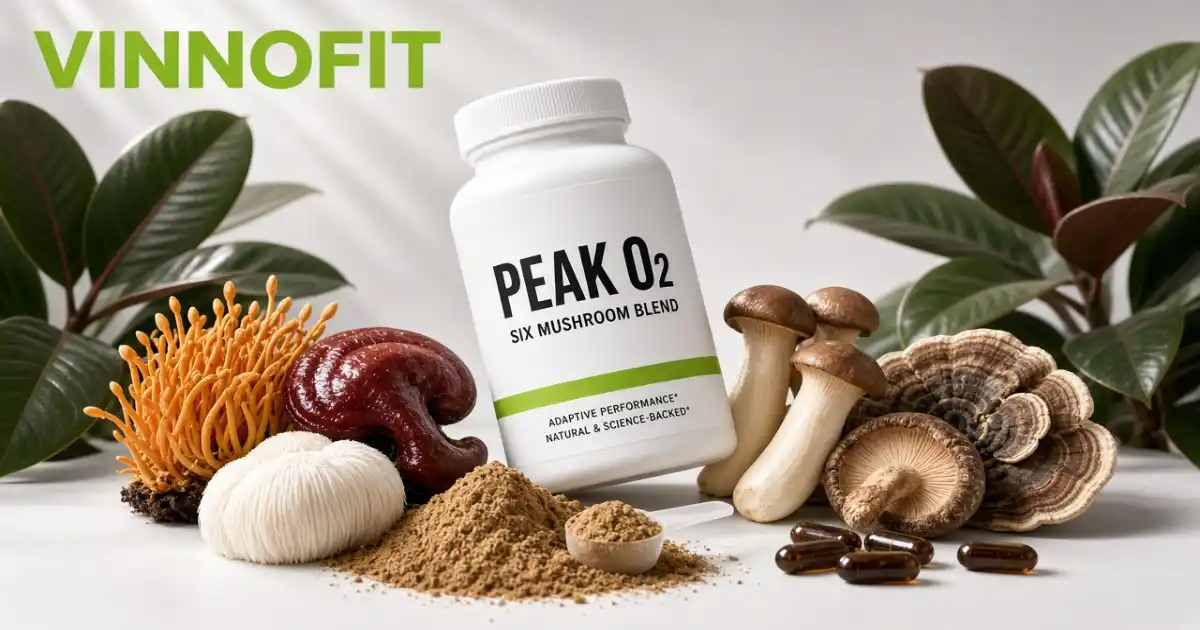
PeakO₂ is a commercial ingredient combining six medicinal mushrooms, marketed for improving aerobic endurance and delaying fatigue. There is real research behind it — but with small samples, manufacturer funding, and results that aren't uniformly positive. This guide covers the ingredients and the proposed mechanism, and reads the evidence as it stands: what held up, what didn't, and how long it takes before you can judge it.
What is PeakO₂?
PeakO₂ is a registered trade name for a blend of six medicinal mushrooms produced by the American company Compound Solutions, organically grown on defined substrates in the United States. It's rarely sold on its own — it appears as an ingredient inside pre-workout and endurance products.
The primary component is Cordyceps militaris, with the others present in smaller proportions. Alongside the mushrooms, the product supplies beta glucans, ergothioneine, and some vitamin D₂ produced during cultivation.
The central marketing claim: improved oxygen utilisation and delayed fatigue in high-intensity exercise — an endurance supplement, not a mass-building one.
The six mushrooms and what each contributes
| Mushroom | Scientific name | Attributed role |
|---|---|---|
| Cordyceps | Cordyceps militaris | Primary component; oxygen utilisation and endurance |
| Reishi | Ganoderma lucidum | Stress adaptation and immune support |
| King Trumpet | Pleurotus eryngii | Ergothioneine and antioxidants |
| Shiitake | Lentinula edodes | Beta glucans and immune support |
| Lion's Mane | Hericium erinaceus | Attributed cognitive support |
| Turkey Tail | Trametes versicolor | Polysaccharides and immune support |
An important caveat: the studies tested the complete blend, not each mushroom individually. Any claim that "the lion's mane in the formula sharpens focus" rests on separate research at different doses, not on the PeakO₂ trials themselves.
Cordyceps militaris, not sinensis — a real distinction
Two entirely different species get conflated:
- Cordyceps sinensis: the wild species that grows on insect larvae on the Tibetan plateau — so rare and expensive that its genuine presence in a cheap supplement is near impossible. Most of what sells under this name is lab-cultivated.
- Cordyceps militaris: the commercially cultivated species, used in PeakO₂ and in most serious supplements. It contains a higher proportion of cordycepin than the wild species.
This isn't academic trivia: when a product boasts "wild Cordyceps sinensis" at an ordinary price, the likeliest reality is cultivated powder or mycelium on grain. Being able to read the label is what separates one product from another here.
The proposed mechanism
The core hypothesis is that cordycepin — an adenosine analogue — may act on cellular energy pathways and oxygen utilisation, improving what's called oxygen kinetics: how quickly the body ramps up oxygen consumption when effort begins.
Added to that are the blend's beta glucans and antioxidants, plus ergothioneine, an antioxidant that accumulates in tissues under high oxidative stress.
But the part usually left unsaid: these are proposed mechanisms extrapolated from in vitro and animal work, not pathways demonstrated in humans. The available human studies measured endpoints (VO₂ max, time to exhaustion) without establishing the route taken to them.
What the studies actually show
Three studies are usually cited. Here's the careful reading:
2017 study (University of North Carolina)
28 participants, randomised double-blind placebo-controlled, 4 g per day. Results:
- After one week: no statistically significant difference in anything — not VO₂ max, ventilatory threshold, time to exhaustion, or peak power.
- After three weeks: a significant improvement in VO₂ max in the mushroom group (+4.8 ml/kg/min) versus a marginal change on placebo (+0.9).
But that second phase included only ten volunteers — a sample small enough to widen the error margins considerably.
2015 ISSN conference poster
From the same research group, 10 participants over three weeks. It pointed to possible improvement in VO₂ max and time to exhaustion, but the increase in peak power was not statistically significant. It's a conference poster rather than a full peer-reviewed paper, and it was funded by a supplement company.
2018 study
Compared a low dose (1–2 g daily for 28 days) against a high dose (12 g daily for 7 days). The long, low-dose arm showed improvements in time to fatigue and VO₂ max with lower blood lactate — meaning duration matters more than dose.
The honest summary: a repeated positive signal toward improved aerobic endurance after 3–4 weeks, but on small samples, with manufacturer funding, and without broad independent replication. This isn't "proven" in the sense creatine or caffeine are — and it isn't baseless either.
Dose, duration and timing
The doses used in research ranged from 1 to 4 grams per day taken continuously, which is the range most commercial products follow.
The critical variable isn't dose but duration: studies found no difference after one week, with results appearing at three to four weeks. Taking it "30 minutes before training" for an immediate effect isn't a use the data supports — this is a cumulative supplement like creatine, not a stimulant like caffeine.
Time of day doesn't much matter; consistency does. To evaluate it fairly: run it for four unbroken weeks with everything else held steady (sleep, training, nutrition), and measure something objective — a time over a fixed distance, or power in a defined test — rather than how you feel.
Who it may suit, and who it won't
May suit: endurance athletes, people doing high-intensity interval work, and anyone trying to raise training volume without accumulating excessive fatigue. Every positive finding in the research was in an aerobic or endurance measure.
Not a priority for: anyone chasing size or maximal strength — there's no data supporting an effect on muscle mass or lifting. And anyone who hasn't yet sorted out sleep and nutrition: the effect of any supplement is marginal next to what one bad night costs you.
For comparison with better-evidenced supplements, see our whey protein guide and the rest of the supplement guides.
Safety and side effects
The available studies recorded no notable side effects at the doses used, and the constituent mushrooms are either edible or have long traditional use. Even so:
- Mild digestive upset (bloating or nausea) in some people, particularly at higher doses.
- Mushroom allergy: anyone with a known fungal allergy should avoid it.
- Blood thinners: some mushroom extracts may theoretically affect platelet aggregation; anyone on anticoagulants should ask their doctor.
- Autoimmune conditions: beta glucans are theoretically immune-stimulating, so caution applies for anyone on immunosuppressants.
- Pregnancy and breastfeeding: insufficient data, so abstaining is the default.
The available data show no hormonal effect, and it isn't a banned substance in sport — but anyone subject to doping control should choose products with third-party testing certification to avoid incidental contamination.
Quality and how to read the label
The mushroom supplement market is among the most misleading there is, and the differences are real:
- Fruiting body or mycelium on grain? Many cheap products are mycelium powder grown on rice or oats, ending up high in starch and low in active content. Look for "fruiting body" or a clear declaration of the substrate.
- The actual amount: if PeakO₂ sits inside a proprietary blend with no number, you don't know what you're taking — and the studies used 1–4 grams, a quantity hard to hide in a single capsule.
- The trademark: PeakO₂ is a registered name; licensed products state it explicitly with the logo and the dose.
- Third-party testing for heavy metals — mushrooms absorb what's in their substrate, and this point deserves more attention than any other.
To check whether a supplement in your hands is genuine, try our genuine vs counterfeit supplement test.
Combining it with other supplements
No known conflicts with common supplements. The practical logic:
- Caffeine: works by a completely different mechanism (acute stimulant), so no conflict — but don't start both at once, or you won't know where any improvement came from.
- Creatine: targets the short-duration anaerobic system while PeakO₂ targets endurance — separate pathways, no overlap.
- Beta-alanine: targets acid buffering in medium-duration efforts, and may theoretically complement it.
- Nitrates (beetroot juice): also target oxygen efficiency, so the claims overlap here — start with one and evaluate it before adding the other.
The general rule: change one variable at a time, or you'll pay for four products to learn the effect of none of them.
Common myths
"It works from the first dose": the studies found no significant difference after a full week; results appeared at three weeks.
"It builds muscle": no data supports that; every positive finding was in aerobic endurance measures.
"Wild cordyceps is stronger": the cultivated Cordyceps militaris contains more cordycepin, and the wild species is rare, expensive and rarely genuinely present in products.
"It's natural, so it's safe for everyone": allergy, and interactions with anticoagulants and immunosuppressants, are real considerations.
"The evidence is conclusive": the studies are small and manufacturer-funded, without broad independent replication.
Related reading
Frequently asked questions
How long does PeakO₂ take to work?
Three to four weeks of consistent daily use. Studies found no significant difference after one week, which is the single most important thing to know before buying it.
What dose was used in the research?
Between one and four grams daily. One study found a low dose over 28 days outperformed a high dose over 7 days — duration matters more than quantity.
Does it help with lifting and muscle gain?
No data supports that. Every positive finding was in VO₂ max and time to exhaustion — aerobic endurance.
Is the evidence strong?
Moderate to weak: the direction is positive and repeated, but samples are small (10–28 participants), funding came from manufacturers, and there's no broad independent replication.
Does it have side effects?
The studies recorded none of note. Mild digestive discomfort can occur, and caution applies with mushroom allergy, anticoagulants, immunosuppressants, and in pregnancy.
How do I pick a good product?
Look for PeakO₂ named with a gram amount rather than buried in a proprietary blend, fruiting body rather than mycelium on grain, and third-party testing for heavy metals.
Sources
- Hirsch et al. — Cordyceps militaris Improves Tolerance to High-Intensity Exercise After Acute and Chronic Supplementation (J Diet Suppl, 2017)
- Hirsch et al. — Chronic supplementation of a mushroom blend on oxygen kinetics, peak power, and time to exhaustion (JISSN, 2015)
- Wesley et al. — High and low-dose Cordyceps militaris-containing mushroom blend after 7 and 28 days (summary)
- Industry coverage of the PeakO₂ trial design and funding