

No more guessing how much protein, carbohydrate and fat you need. This free calculator uses the scientifically validated Mifflin-St Jeor equation — the most accurate formula for basal metabolic rate — to give you an exact daily macro target based on your goal (losing weight, bulking or maintaining). Just fill in the form below.
Click the image for a larger version and the full detail.
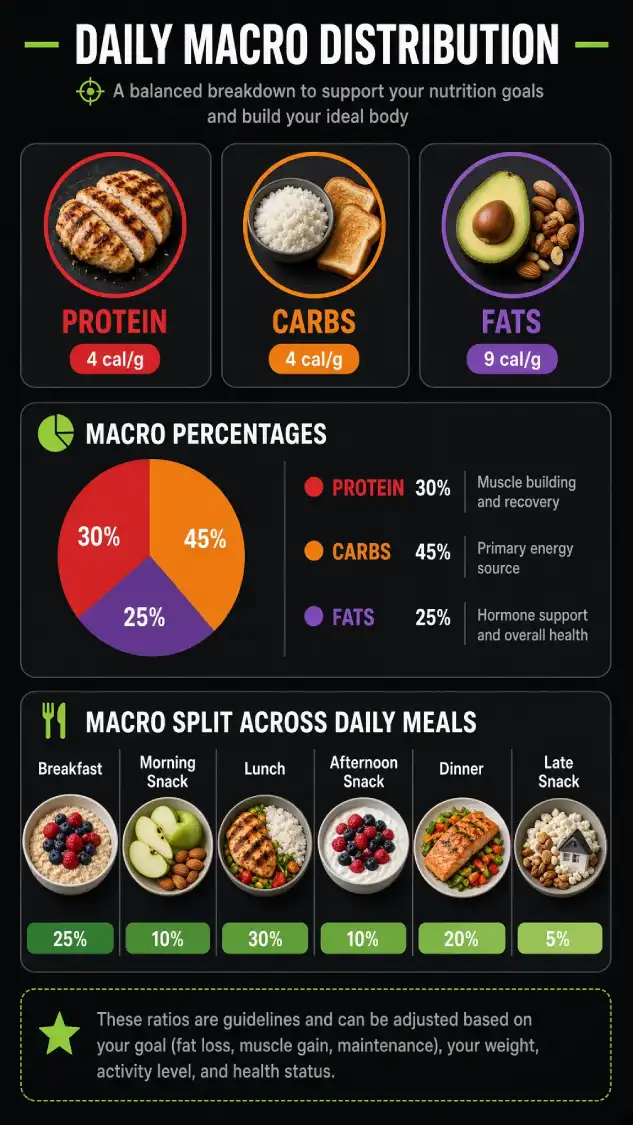
Macros — protein, carbohydrates and fat — are your body's primary fuel. The difference between someone who trains for months with nothing to show for it and someone who reaches their goal quickly often comes down to one precise number: the right amount of macros. This free Vinnofit calculator uses the scientifically validated Mifflin-St Jeor equation to estimate your basal metabolic rate (BMR) first, then your total daily energy expenditure (TDEE), and finally the exact macros that suit your goal.
The numbers below are your scientific starting point. Every body is different, so after two to three weeks check your weight and the mirror, and adjust your calories a little if you need to:
Calculating your macros is only one piece of the puzzle. For a complete, precise plan, try these other free Vinnofit tools:
Want to turn these numbers into a personalised training and nutrition plan?
Sign up free with VinnofitMacros, or macronutrients, cover three main categories: protein, carbohydrates and fat. These three are your body's primary energy sources. Each gram of protein and carbohydrate provides 4 calories, while each gram of fat provides 9. Getting the balance between these three right is the key to reaching any physique goal.
Just enter your sex, age, height, weight, activity level and goal in the form at the top of this page. The Vinnofit calculator uses the Mifflin-St Jeor equation to work out your basal metabolic rate and daily calories first, then shows you the exact amount of protein, carbohydrates and fat you need each day.
During a cutting phase, 1.6 to 2.2 grams of protein per kilogram of body weight is recommended. High protein intake in a calorie deficit prevents muscle breakdown and keeps you fuller, both of which are essential for losing weight successfully.
Mifflin-St Jeor is one of the most reliable and accurate ways to estimate basal metabolic rate in healthy people, and studies have found it has a lower margin of error than older formulas such as Harris-Benedict. Even so, its result is a scientific starting point — it's best adjusted after a few weeks based on how your weight actually changes.
Not necessarily. Your weekly average matters more than any single day. If you go a little over or under on one day, you can balance it out across the others. Long-term consistency beats being perfect for one day.